
The wiki
Orders and judging
How guests ask, and what they make of the plate.
Every guest says what they want in their own words. The same crêpe can be asked for a dozen ways: "The red jam one, rolled" is a Rouge-Gorge; so is "Alizarin crimson on raw canvas, rolled like a poster tube".
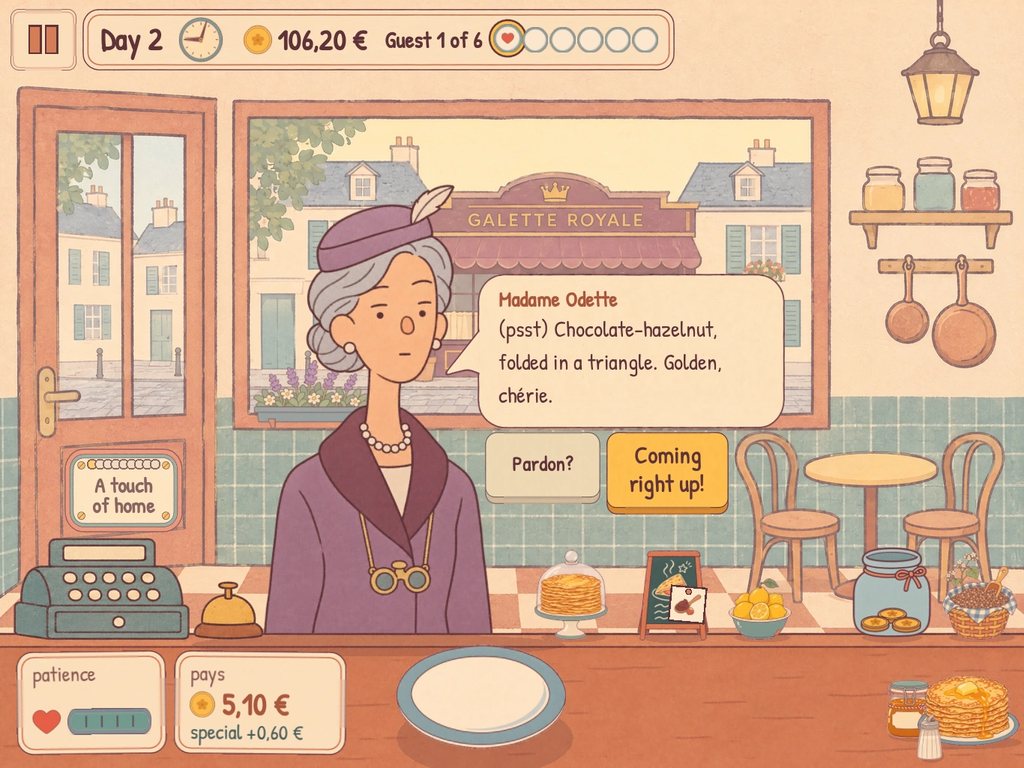
Plain, quirky and riddles
- A plain order says it straight. There is no pad: the guest's sentence is all there is. Not sure? Ask "Pardon?".
- A quirky order is a little poetic. The pad shows three question marks (filling, fold, cook) and "Guess right: bigger tip". Work it out and you earn more; ask "What do you mean?" and the pad fills in with pictures and plain words.
- A riddle ticket shows only the guest's quote.
Asking is never wrong; it just gives up the little bonus for understanding by yourself.
What an order says
The ticket in the kitchen carries everything the guest asked for: the fillings and how much of each, the fold, the doneness, the flour (once you have buckwheat) and a paper bag if it is to take away. A guest who names no amount gets the usual helping; anything else ("just two banana slices", "plenty of honey") is written on the pad.
Takeaway slips
Some days somebody comes in with a written list: a slip of two or three crêpes for one bag. They are cooked one after another without leaving the kitchen, and handed over together.
How a plate is judged
The guest looks at the plate before they taste it, and their face can only be as happy as what they see:
| On the plate | At best they are | |
|---|---|---|
| Nothing to fault, and cooked really well |  | Hearts |
| A scruffy fold, too much or too little of a filling, a filling all on one side or over the edge, creases, a late flip, an extra filling |  | No hearts: they say what they saw |
| A fold that came apart or is not the one ordered, a burnt or raw side, never flipped, torn, a filling missing, the wrong flour, the wrong colour |  |
The money is the crêpe's price, adjusted for how good it was, plus a tip. The till slip on the counter shows one number, the tip, and one thing to fix or one thing done well.
Patience
A guest's patience shows on the gauge under their ticket. It runs down slowly while you cook; at a quarter left the ticket rattles and the guest's face changes. Run out and the crêpe is worth less; a guest who waits far too long leaves. Some guests are much more patient than others: see guests.